
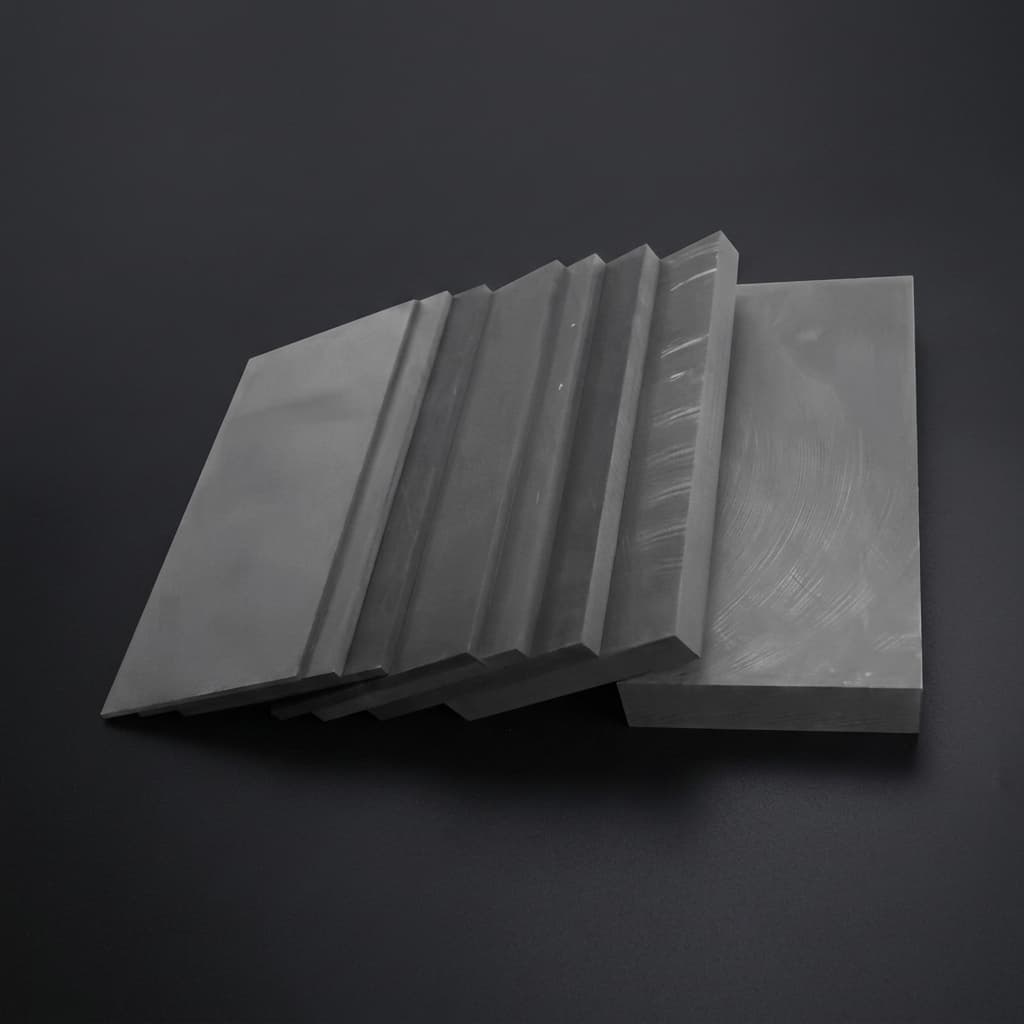
Isostatic vs. Molded Graphite: Which Grade Should You Choose?
An engineering guide comparing isostatic and molded graphite. Learn about grain size, density, strength, and how to select the right graphite grade for EDM, continuous casting, and vacuum furnaces.
Decision-Level Conclusion: The choice between isostatic and molded graphite depends entirely on your application's requirements for grain size, isotropy, and budget. Isostatic graphite offers ultra-fine grain structures (often <10μm), high strength, and identical properties in all directions (isotropy)—making it non-negotiable for precision EDM electrodes and semiconductor components. Molded graphite is more economical, has a coarser grain structure, and is highly directional, which is perfectly acceptable for large-volume heating elements, continuous casting dies, and high-temperature crucibles.
When engineers and procurement teams source custom graphite parts, one of the most common hurdles is selecting the correct raw material grade. With hundreds of proprietary grade names on the market, understanding the underlying manufacturing process—specifically the difference between isostatic pressing and molding/extrusion—is critical to controlling costs and preventing premature part failure.
In this deep-dive guide, we will break down the exact physical differences, compare mechanical properties side-by-side, and provide a buyer's framework for making the right material selection without overspending.
1. The Manufacturing Process: Why It Matters
To understand the difference in performance, you must understand how the block of graphite is formed before it is baked and graphitized.
Isostatic Graphite (Cold Isostatic Pressing - CIP)
Isostatic graphite is manufactured by placing the raw carbon powder mixture (petroleum coke and pitch binder) into a flexible, sealed rubber mold. This mold is then submerged in a liquid (usually water or oil) inside a high-pressure vessel. Pressure is applied to the liquid, compressing the powder equally from all 360 degrees.
- The Result: Because the pressure is perfectly uniform, the grains are packed tightly and evenly without aligning in any specific direction.
- The Drawback: The equipment required for CIP is expensive, and the size of the final block is limited by the diameter of the pressure vessel.
Molded / Extruded Graphite (Uniaxial Pressing)
Molded graphite is formed by pouring the powder into a rigid steel die. A massive hydraulic ram then presses the powder from one direction (top-down). In extrusion, the material is forced through a die to form long rods or rectangular blocks.
- The Result: The mechanical pressure forces the flat, plate-like coke particles to align perpendicular to the pressing direction.
- The Drawback: This alignment means the block will conduct heat and electricity differently depending on which way you measure it. It will also be stronger in one direction than the other.
2. Head-to-Head Property Comparison
Below is a generalized comparison table showcasing the typical physical properties of a premium Isostatic Graphite versus a standard Molded Graphite block.
| Property | Isostatic Graphite (Typical) | Molded Graphite (Typical) | Why It Matters for Buyers |
|---|---|---|---|
| Grain Size | 1μm – 15μm (Ultra-Fine) | 0.8mm – 4.0mm (Coarse) | Finer grains allow for razor-sharp machined edges. Coarse grains will chip if machined too thin. |
| Bulk Density | 1.75 – 1.90 g/cm³ | 1.65 – 1.75 g/cm³ | Higher density means less porosity, better oxidation resistance, and longer lifespan in furnaces. |
| Flexural Strength | 45 – 70 MPa | 15 – 30 MPa | Isostatic graphite can withstand much higher mechanical loads and vibrations before snapping. |
| Shore Hardness | 50 – 70 | 30 – 45 | Harder graphite resists wear better, which dictates performance for continuous casting dies and EDM wear. |
| Isotropy | Isotropic (1.0 ratio) | Anisotropic (1.1 - 1.5 ratio) | Isotropic material expands and conducts evenly in all directions. Anisotropic material requires careful CNC orientation. |
| Relative Cost | High ($$$) | Low to Medium ($) | Don't over-specify. Use isostatic only when the engineering dictates it. |
3. When to Insist on Isostatic Graphite
Do not compromise on material grade in the following scenarios. Using a cheaper molded grade will result in immediate part failure or rejected components.
Precision EDM Sinker Electrodes
When machining EDM Electrodes, the electrode must hold sharp internal corners and thin ribs without crumbling in the EDM tank. Furthermore, the spark gap erosion depends heavily on the grain size of the graphite. If you want a VDI 18 surface finish on a plastic injection mold, you absolutely must use an isostatic graphite with a grain size of 5μm or smaller.
Semiconductor and Monocrystalline Silicon Pulling
In the CZ (Czochralski) process for pulling silicon ingots, the graphite hot zone parts (heaters, susceptors, crucibles) are subjected to extreme heat. Any uneven thermal expansion (anisotropy) will cause the susceptor to warp, destroying the silicon crystal growth. Furthermore, semiconductor applications demand ultra-high purity (ash content < 5 ppm), which is predominantly available in isostatic grades.
Extreme Precision CNC Components
If your CAD drawing calls for a wall thickness of 0.5 mm or a tight ± 0.01 mm tolerance, you must use isostatic graphite. The coarse grains of molded graphite will simply tear out under the CNC endmill, leaving a jagged, unusable edge.
4. When Molded Graphite is the Smarter Business Choice
Many engineers over-specify isostatic graphite, inflating their BOM costs by 200% to 300% for no functional reason. Molded graphite shines in bulk, high-heat applications.
Vacuum Furnace Hot Zones
Industrial vacuum furnace hot zones require massive graphite heating elements, hearth rails, and insulation boards. These parts are thick, structurally simple, and operate in static environments. Molded graphite is exceptionally resistant to thermal shock due to its slight porosity, making it the perfect, cost-effective choice for furnace rebuilds.
Non-Ferrous Continuous Casting Dies
When casting large brass, copper, or cast iron billets, standard molded graphite dies perform exceptionally well. While isostatic graphite might yield a slightly smoother surface on the cast metal, the low cost of molded graphite dies makes them economically superior for high-volume foundries where dies are consumed rapidly.
Sintering Trays and Boats
For powder metallurgy and ceramic sintering, carbon graphite wear parts and loading trays carry heavy loads at high temperatures. As long as the trays are designed with sufficient thickness, extruded or molded graphite provides excellent dimensional stability and ROI over thousands of heating cycles.
5. The Buyer's Sourcing Checklist: Verifying Your Grade
One of the biggest risks when sourcing graphite overseas is material substitution. Because isostatic and molded graphite look visually identical (both are black blocks of carbon), unscrupulous suppliers may quote the premium isostatic price but deliver high-quality molded material.
How to protect yourself from material fraud:
- Request the Factory Material Data Sheet (MDS): Always ask for the MDS before issuing a PO. Look specifically at the Grain Size and Compressive Strength. If the grain size is listed as "0.8mm", you are buying molded graphite.
- Specify Known Equivalents: If you need guaranteed performance, specify known benchmark grades (e.g., Toyo Tanso IG-11, SGL R8650, Mersen 2191, POCO EDM-3) and ask your supplier to legally guarantee their material matches those specific mechanical properties.
- Conduct a "Snap Test" on Samples: If you order a 2mm thick sample plate, isostatic graphite will snap with a sharp, ceramic-like fracture. Molded graphite will often crumble slightly at the break line due to the larger grains.
- Partner with Transparent Machinists: Work with a supplier who maintains a strict chain of custody for their raw blocks.
At Custom Graphite Parts, we run a rigorous drawing-to-shipment workflow where the material grade is locked in, certified, and verified before the first chip is cut on the CNC mill.
Need help selecting the exact grade for your next thermal or machining project? Contact our engineering team for a free material recommendation and an RFQ review.
Engineering FAQ: Graphite Grades
1. Can I visually tell the difference between isostatic and molded graphite?
Generally, no. Both appear as dense black carbon blocks. However, if you examine a machined surface under magnification (or observe how it holds a sharp edge), isostatic graphite will look uniformly smooth, whereas molded graphite will reveal small pits and grain pull-outs.
2. Is isostatic graphite always more expensive?
Yes. The Cold Isostatic Pressing (CIP) manufacturing process requires high-pressure liquid chambers and a significantly longer baking and graphitization cycle. Expect isostatic graphite to cost 2x to 4x more than standard molded graphite by weight.
3. Which grade should I use for EDM electrodes?
You must use isostatic graphite. The ultra-fine grain size (<10µm) is required to replicate sharp internal corners and fine details without the electrode crumbling under the electrical discharge arc.
Author
Graphite CNC machining, EDM electrode, mold tooling, and export-aware sourcing specialists.
Categories
More Posts
Graphite Rotors and Shafts for Aluminum Degassing: Wear Resistance and Lifespan Optimization
A comprehensive engineering and procurement guide to extending the lifespan of graphite degassing rotors in aluminum foundries. Learn about high-temperature oxidation, anti-oxidation coatings, material selection, and operational best practices.
Graphite CNC Machining Design Guide: Tolerances, Threads, and Cost Drivers
Designing custom graphite parts? Read our CNC machining guide covering standard tolerances, threading considerations, wall thickness limits, and tips to reduce your manufacturing costs.
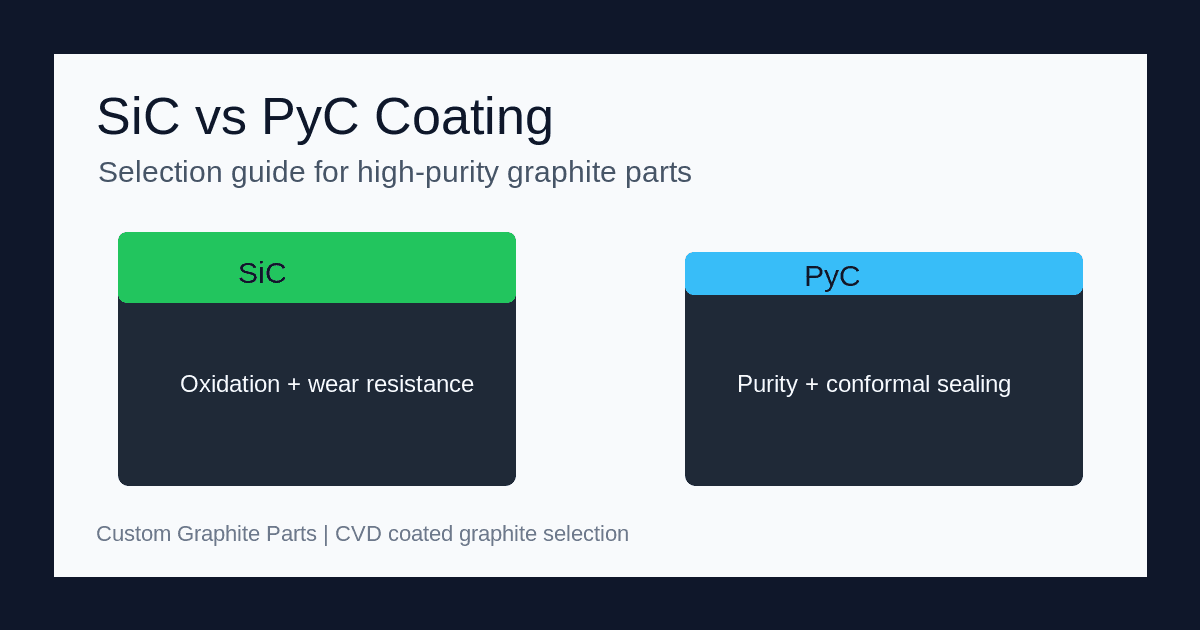
Silicon Carbide (SiC) vs. Pyrolytic Carbon (PyC) Coating on Graphite Parts: A Selection Guide
SiC vs PyC coating selection guide for graphite parts in semiconductor, furnace, and crystal-growth service, with limits, risks, checklist, and RFQ guidance.