| Isostatic Graphite | Best for engineers requiring isotropic properties, high precision, and extreme high-temperature stability. | Grain Size: 5 - 15 microns | Finer grain provides smoother surface finishes and better edge retention in CNC and EDM processes. |
| Molded & Extruded Graphite | Best for procurement teams sourcing large furnace components or standard wear parts where extreme precision is secondary to cost. | Grain Size: 0.8 - 3.0 mm | Coarser grain provides better thermal shock resistance but limits fine detail machining. |
| Surface Treatments & Purifications | Best for applications failing prematurely due to oxidation, permeability, or contamination. | Ash Content (Purified): < 5 ppm (often < 2 ppm) | Prevents metal ion contamination in semiconductor crystal growth processes. |
| Graphite Grade Comparison | Best for engineers and buyers who know the application but need help translating performance needs into a graphite material route. | Selection basis: Exact grade, buyer-approved equivalent, or application-based recommendation | A grade name alone is not enough unless the buyer also defines acceptable substitution rules and certificate requirements. |
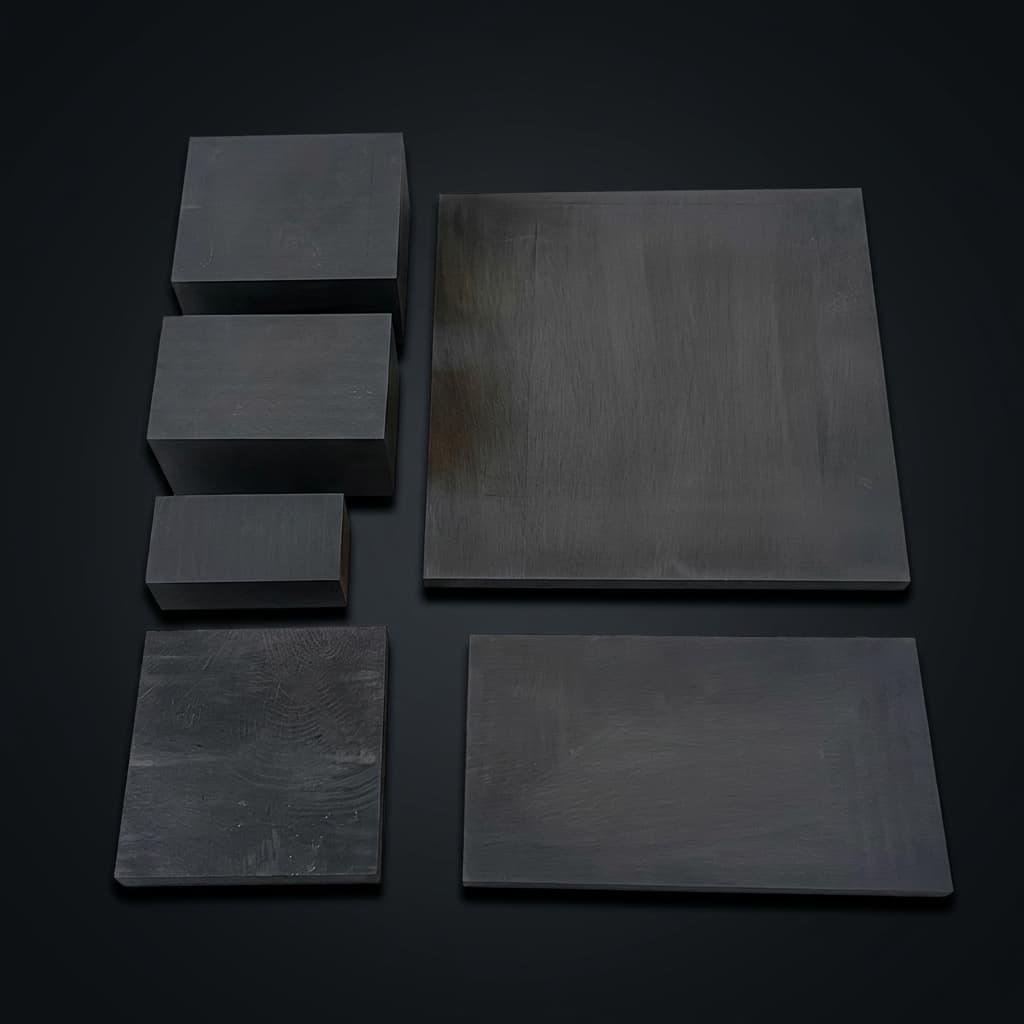
| Vibration Molded Graphite | Best for buyers sourcing larger graphite parts or fixtures where isostatic graphite may be unnecessary or too costly. | Section size: Medium to large blocks, plates, molds, and fixtures | Large finished dimensions can limit available material families and influence cost. |
| Resin-Impregnated Graphite | Best for buyers who need graphite parts in gas, liquid, chemical, sealing, or porosity-sensitive service. | Porosity sensitivity: Low, moderate, or high leakage concern by buyer application | Impregnation decisions should be tied to actual gas or liquid service requirements. |
| SiC and Pyrolytic Carbon Coated Graphite | Best for engineers and buyers who need graphite performance beyond bare material and must coordinate machining, coating, inspection, and documentation. | Coating purpose: Oxidation, corrosion, contamination, erosion, or process-contact improvement | The reason for coating determines material route, acceptance criteria, and inspection priorities. |
| Expandable Graphite & Flame Retardants | For material scientists, chemical compounders, and EV battery engineers seeking eco-friendly, highly effective fire protection additives. | Expansion Volume: 150 - 350+ ml/g | Determines the thickness and effectiveness of the insulating char layer formed during a fire. |