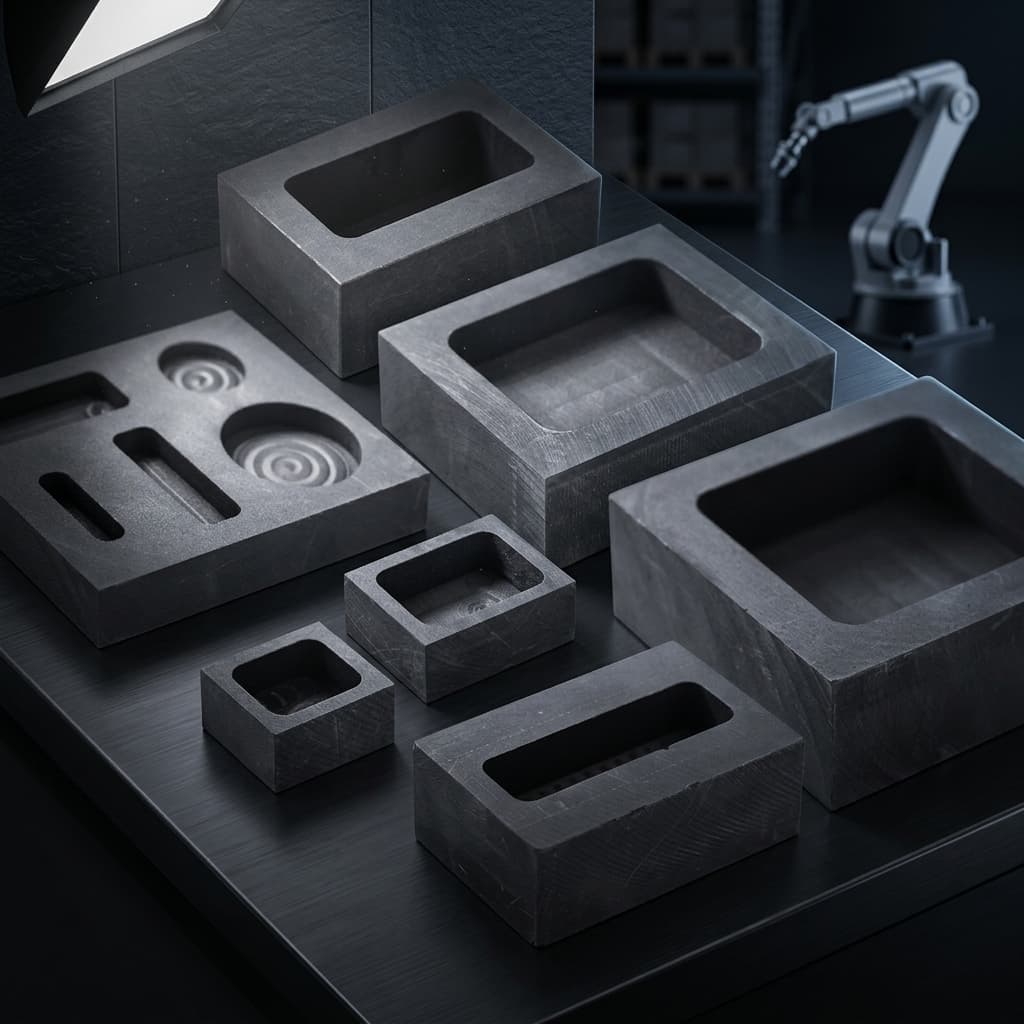
Why is isostatic graphite usually the first candidate?
Isostatic graphite is preferred when a hot bending mold needs uniform thermal expansion, fine machining response, and stable cavity geometry. The exact grade still has to be confirmed from supplier data for grain size, density, ash, CTE, and available billet size.
Can the mold run in open air?
Open air can be acceptable for short trials at lower temperatures, but it is not a production default for high-temperature 3D cover glass bending. If oxygen reaches graphite above roughly 400°C, oxidation risk rises and a nitrogen, argon, vacuum, coating, or short-cycle trial must be reviewed.
Is Ra < 0.4 μm always required?
No. Optical cover glass, display covers, and polished cosmetic surfaces usually need a much tighter mold contact finish than architectural or non-visible curved glass. The drawing should state the glass-side finish target and which cavity zones are critical.
Does grain size alone guarantee a good glass surface?
No. Fine grain helps, but glass transfer also depends on polishing, ash/impurity level, local porosity, coating choice, dust control, release behavior, and the actual temperature-pressure-time cycle.
Should we use SiC, pyrolytic carbon, or bare graphite?
Bare ultra-fine graphite is often the simplest prototype route. Coatings can improve oxidation or release behavior, but they may change surface finish, lead time, cost, and repair strategy. Decide after reviewing atmosphere, oxygen level, target finish, and expected mold replacement interval.
What tolerance should be quoted?
Quote the drawing tolerance that matters to assembly and glass profile, not a generic mold tolerance. For precision 3D glass molds, cavity profile, datum strategy, edge radius, release clearance, and inspection method are more important than one blanket tolerance number.
Can cycle life be estimated before sampling?
Only as a planning band. Useful cycle life depends on oxygen exposure, setpoint, hold time, surface area, coating, cleaning, release agent, glass chemistry, and handling damage. The RFQ should separate prototype validation from production life targets.
What should be sent for RFQ?
Send STEP/IGES or 2D drawings, glass material and thickness, forming temperature, hold time, atmosphere, surface finish target, coating preference, inspection datum, quantity, destination country, and whether export documents or material certificates are required.