
Custom Graphite Parts logoCustom Graphite Parts
Start inquiry
Custom Graphite Parts logoCustom Graphite Parts
WhatsApp
Custom Graphite Parts logoCustom Graphite Parts

Custom graphite CNC machining, graphite molds, EDM electrodes, high-purity graphite components, and export-compliant sourcing support.

Inquiry Email

[email protected]

Email RFQ

Complete RFQs are easier to review within 1-2 business days when drawings, grade, quantity, and destination are included.

WhatsApp Alignment

+8618857971991

Chat on WhatsApp

Use WhatsApp for quick alignment; send drawings by email for traceable review.

Products
  • Custom Graphite Parts
  • Custom Graphite Molds
  • Graphite EDM Electrodes
  • High-Purity Graphite
  • SiC Coated Susceptors
  • Graphite Bipolar Plates
  • 3D Glass Hot Bending Molds
  • Graphite Heaters & Crucibles
  • Graphite Furnace Fixtures
  • Carbon Graphite Wear Parts
Materials
  • Isostatic Graphite
  • Molded & Extruded
  • Surface Treatments
  • Grade Comparison
  • Vibration Molded Graphite
  • Resin-Impregnated Graphite
  • SiC & Pyrolytic Carbon Coated
Solutions
  • EDM Electrode Sourcing
  • Semiconductor Consumables
  • Semiconductor Crystal Growth
  • Fuel Cell & Flow Battery Plates
  • Vacuum Furnace Hot Zone
  • Continuous Casting Tooling
  • Export-Controlled Sourcing
OEM Capabilities
  • Graphite CNC Machining
  • Export Compliance Support
  • Dust-Controlled Machining
  • Drawing-to-Shipment
  • Quality & Traceability
  • Fragile Graphite Packing
Resources
  • Blog
  • About
  • Contact / RFQ
  • Privacy Policy
  • Cookie Policy
  • Terms of Service
© 2026 Custom Graphite Parts. All Rights Reserved.|Backed by Linkup Ai Co., Ltd. Manufacturing delivered by the Advanced Manufacturing Division of Linkup Precision.
← Back to Products

3D Glass Graphite Molds

Precision fine-grain graphite molds for 3D glass hot bending, built around glass datasheet review, furnace atmosphere control, polished cavity surfaces, and dimensional repeatability.

Primary Job

Screen mold grade, atmosphere risk, and RFQ readiness.

Evidence Layer

Dated public sources plus explicit process limits.

Send RFQ InputsReview Source Basis
Interactive Tool
3D Glass Graphite Mold Applicability Checker
Use a bounded RFQ pre-check for graphite grade, polish target, mold life context, and the next process data to send.
700°C

Required range: 550-900°C. Typical initial review window: 600-850°C.

Default basis
Baseline assumes Smartphone 3D cover glass, N2 protected, O2 target <100 ppm, and a drawing-based RFQ review. The checker is deterministic for the same inputs.

Preliminary Fit

Good preliminary fit

Recommended Grade

Ultra-fine isostatic graphite, 3-10 um average grain target

Mold Life

500-1000 cycles before planned polish review

Target Surface

Ra <= 0.4 um after cavity polishing

Risk

Controlled production window

Confidence

Medium

Boundaries & Conditions

Assumes a protected N2 or inert furnace, drawing-level CTE compensation, and clean packing after final polishing.

RFQ Checkpoints

  • Confirm exact glass CTE and softening/annealing data from the customer datasheet.
  • Confirm cavity polish method, edge radius, and inspection datum before machining.
  • Confirm O2 monitoring point and purge recovery plan for the hot bending furnace.

Send the STEP file, glass datasheet, cycle time, and target Ra so the mold grade and compensation offset can be locked.

Request RFQ Review with These Inputs
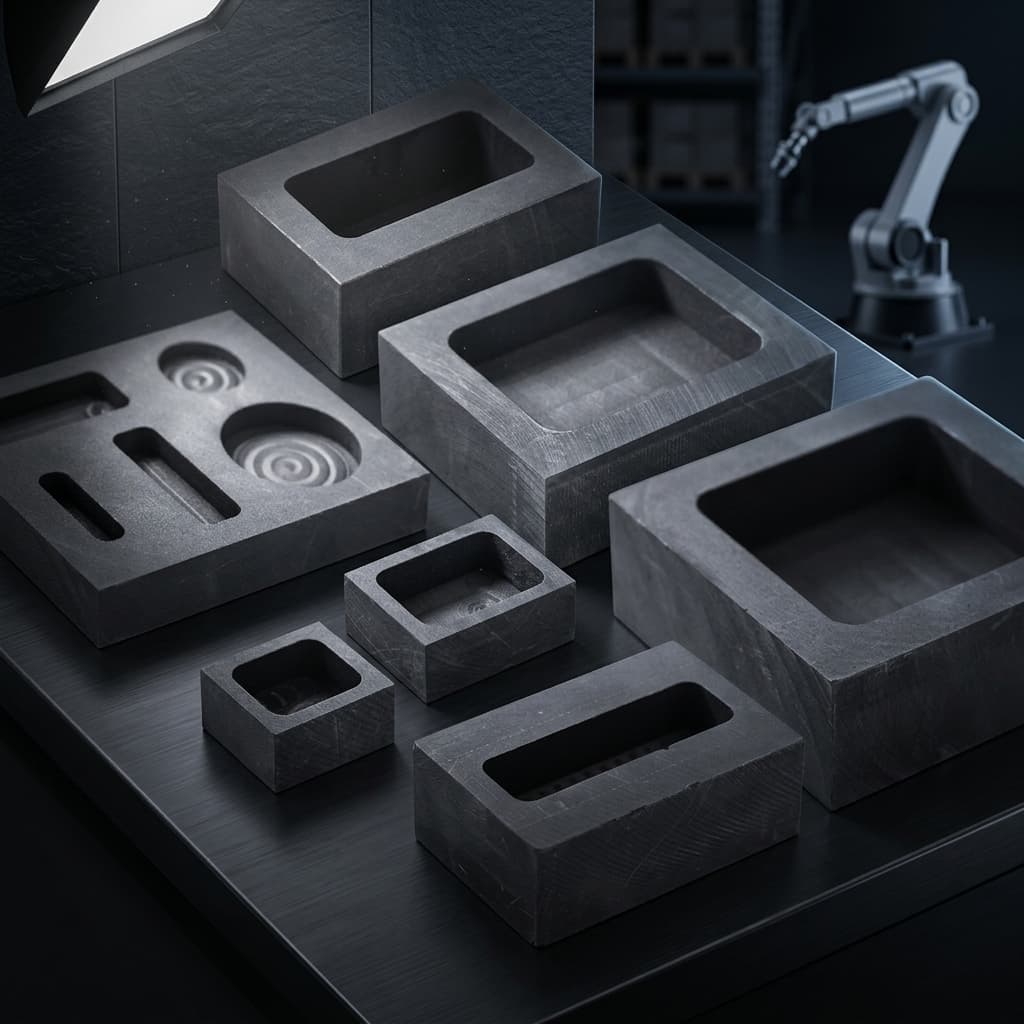
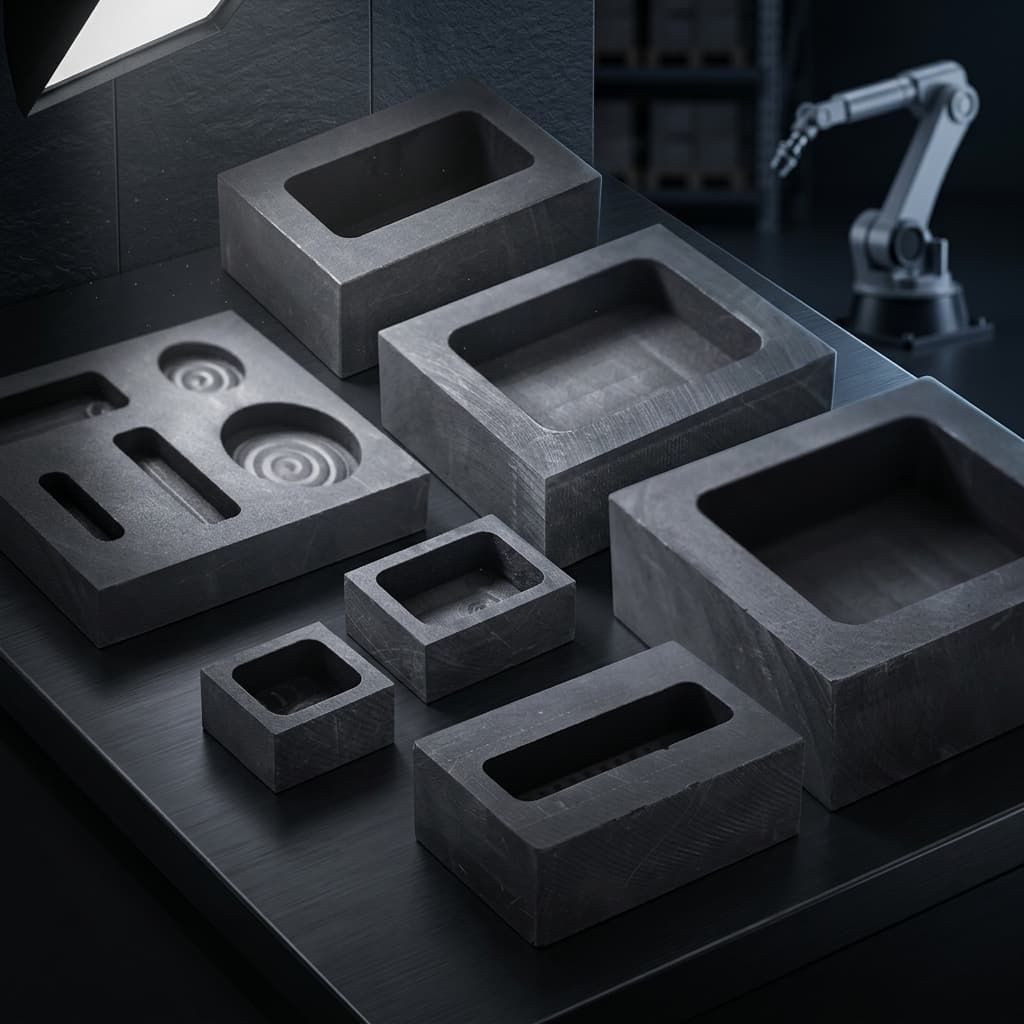
Precision 3D glass hot bending graphite mold with polished cavity
Target Buyer:Ideal for 3D glass forming factories, smartphone OEMs, automotive display suppliers, and hot bending process engineers.

Capability Highlights

  • Ultra-fine grain isostatic graphite for mirror-like glass finish
  • High oxidation resistance for extended hot bending cycle life
  • Precision CNC machining with tight tolerances for complex 3D glass curves

Typical Applications

  • Smartphone 3D cover glass bending
  • Automotive display 3D glass forming
  • Wearable device glass lenses
  • Optical glass molding
  • Smart home appliance curved glass

Engineering Focus

  • Graphite grade selection matched to glass softening points and pressing cycles
  • Thermal expansion matching to prevent glass warping or mold sticking
  • Oxygen exposure review at 600°C-850°C before committing to mold-life claims
  • Chemical strengthening sequence review before bending pre-strengthened glass

Critical Technical Boundaries for 3D Glass Hot Bending

Source-reviewed on July 23, 2026. These boundaries support RFQ screening only; the released mold quote still depends on the customer glass datasheet, drawing, and furnace log.

1. Temperature Window Is RFQ Triage, Not a Recipe

Evidence: The checker uses 600-850°C as a preliminary review window because public cover-glass data puts the strain, annealing, and softening context in that region.

Action: Quote release still needs the exact glass datasheet, peak hold time, cooling profile, and furnace atmosphere log.
2. CTE Mismatch Must Be Compensated in the CAD/CAM Model

Evidence: Public cover-glass CTE and isostatic graphite CTE examples do not match one-for-one, so cavity geometry cannot be copied directly from the cold target shape.

Action: Confirm the glass CTE, mold grade CTE, contact side, forming pressure, and cooling support before final offset machining.

3. Grain Size, Density, and Polish Are Linked

Evidence: Fine isostatic grades are favored because grain size and density influence polish response, particle release, and glass-contact surface stability.

Action: Specify Ra target, allowed pits/haze, polishing sequence, cleaning method, and inspection datum in the RFQ.

4. Chemical Strengthening Is a Process Boundary

Evidence: Ion exchange creates the compressive surface layer; high-temperature forming should not be assumed compatible with already strengthened glass.

Action: Treat hot bending before final strengthening as the default unless the customer process owner signs off on another validated sequence.

Decision Map

Reviewed July 23, 2026
Glass dataCTE + softeningFurnaceO2 + hold timeGraphite gradegrain + densityReleaseRa + QC plan

The tool screens whether the request is ready for automatic RFQ review. The report below explains which evidence still controls production release.

Source Basis & Limits

Public references checked on July 23, 2026. They support the page logic but do not replace customer drawings, internal process recipes, or production qualification.

Decision PointPublic SourceHow It Is UsedLimit
Cover-glass thermal contextCorning Gorilla Glass 6 product information sheetPublic reference values include 572°C strain point, 624°C annealing point, 885°C softening point, and 75.2 x 10^-7/°C CTE.Use only as a public cover-glass reference. The customer glass datasheet controls the mold quote.
Isostatic graphite grade windowSGL Carbon SIGRAFINE ISO graphite technical data sheetPublished isostatic graphite examples list 3-20 µm grain size, 1.72-1.88 g/cm³ density, and 2.7-4.7 x 10^-6/K CTE by grade.Supplier grade, block size, purification, and machining direction still need drawing-level confirmation.
Oxygen exposure riskIdaho National Laboratory graphite oxidation comparisonOxidation behavior changes materially across nominal 550-800°C test temperatures and depends on oxygen transport to the graphite surface.Nuclear graphite tests are not mold-life guarantees; they support oxygen-control risk screening only.
Strengthening sequence boundaryCorning science note on ion-exchange strengtheningCorning explains chemical strengthening as ion exchange that forms a surface compressive layer.Final bend/strengthen order must be approved by the glass process owner and part qualification plan.

RFQ Review After Source Screening

Send the drawing, glass datasheet, peak temperature, atmosphere trend, and target surface finish together so the mold quote can be checked against the same boundaries used on this page.

Send RFQ by EmailDiscuss on WhatsApp

Complete RFQs are easier to review within 1-2 business days when drawings, graphite grade, quantity, and destination are included.

Selection Logic & Constraints

Material OptionBest Fit ApplicationWatchouts & Risks
Isostatic Ultra-Fine Grain GraphiteSmartphone 3D glass and high-end wearables requiring flawless surface finish.Higher initial cost, but lower cost-per-part due to longer mold life.
Standard Fine Grain GraphiteAutomotive displays and larger 3D glass with less aggressive curvature.May require more frequent repolishing in high-volume production.
Anti-Oxidation Treated GraphiteHot bending processes in environments with higher oxygen exposure.Treatment type must be compatible with the specific glass composition to avoid sticking.

Production & QC Flow

  1. Step 1

    Drawing and Hot Bending Process Review

    Evaluate the 3D model against the glass bending temperature, cycle time, and cooling profile.

  2. Step 2

    Material Selection and Grain Size Matching

    Select the optimal graphite grade to balance surface finish, oxidation resistance, and cost.

  3. Step 3

    Precision CNC Machining & Polishing

    Machine the cavity with specialized tooling, followed by polishing to meet strict Ra targets.

  4. Step 4

    CMM Inspection and Clean Packaging

    Verify 3D contour accuracy with CMM and pack securely to prevent edge chipping during transit.

Key Evaluation Matrix

MetricTypical RangeWhy It Matters
Surface Finish (Ra)0.4 - 0.8 µm (or better with special polishing)Directly impacts the optical clarity of the formed 3D glass.
Thermal Expansion Coefficient (CTE)4.0 - 5.5 x 10^-6 /°CMust be compatible with the glass to prevent sticking or cracking during cooling.
Expected Mold Life500 - 1500+ cycles after atmosphere and polish reviewDetermines the tooling cost for mass production runs, but only after temperature, O2 exposure, and cleaning are known.
Furnace Oxygen ControlN2 or inert process with O2 ppm trend suppliedGraphite mold life and glass-contact surface stability depend on oxygen ingress near the hot zone.

RFQ Checklist

  1. Mold 3D model (STEP/IGES) or 2D drawing with tolerances
  2. Glass material datasheet with CTE, strain point, annealing point, and softening point
  3. Hot bending temperature, peak hold time, cooling profile, and cycle time
  4. Furnace atmosphere, O2 ppm trend, purge flow, and leak-recovery notes
  5. Expected mold lifespan (cycles) or monthly production volume
  6. Surface finish (Ra), edge radius, allowed pits or haze, and cleaning requirement
  7. Chemical strengthening sequence and validation owner for the final glass process

Risk Controls

  • Glass sticking to the mold: Specify contact-side finish, graphite grade, release chemistry, and glass cleaning before final mold release.
  • Rapid mold oxidation at high temperatures: Review O2 ppm trend, peak hold time, purge recovery, and anti-oxidation treatment compatibility.
  • Dimensional distortion of the glass: Use the customer glass CTE and selected graphite grade CTE to set cavity compensation and cooling support.
  • Loss of strengthened-glass performance: Confirm whether hot bending occurs before final ion-exchange strengthening unless a validated alternate sequence is approved.

Product Gallery

CNC machined graphite mold for curved 3D glass forming
Custom graphite hot press mold for high temperature forming

Buyer FAQ

What is the best graphite grade for 3D glass hot bending?

Isostatic ultra-fine grain graphite is the usual starting point because dense, fine grades polish more predictably and hold glass-contact surfaces better. The final grade still depends on glass CTE, peak temperature, O2 exposure, cavity geometry, and the required Ra.

How many bending cycles can a graphite mold typically withstand?

For initial costing, buyers often discuss 500-1500 cycles before repolishing or replacement. Treat that as a planning range only; oxygen ingress, hold time, cleaning, release chemistry, and surface finish decide the real maintenance interval.

Can you achieve the tight tolerances required for smartphone glass?

Yes. We utilize high-speed CNC machining centers and CMM inspection to ensure the 3D contours meet strict smartphone OEM tolerances.

What data is required before quoting a production mold?

Send the STEP or IGES model, 2D tolerances, glass datasheet, target Ra, peak temperature, hold time, cooling profile, atmosphere/O2 log, required cycle life, and expected monthly volume.

Can one graphite mold design cover several glass grades?

Only after engineering review. Different glass CTE, softening behavior, thickness, coating, and strengthening sequence can change cavity compensation and sticking risk.

Should 3D glass be chemically strengthened before or after bending?

The default assumption is hot bending before final ion-exchange strengthening. If the customer wants to bend already strengthened glass, the process owner should provide qualification evidence before the mold is released.

When is anti-oxidation treated graphite recommended?

It is considered when peak temperature, hold time, or oxygen exposure increases oxidation risk. Treatment choice must be checked against glass-contact cleanliness and sticking behavior.

Related Resources

  • Isostatic Graphite Materials
  • Graphite CNC Machining Services
  • 3D Glass Hot Bending Mold Fit Checker
  • 3D Glass Graphite Molds Manufacturer
  • 3D Glass Graphite Molds Supplier
  • Contact for 3D Glass Mold RFQ

Inquiry Email

[email protected]

Email RFQ

Complete RFQs are easier to review within 1-2 business days when drawings, grade, quantity, and destination are included.

WhatsApp Alignment

+8618857971991

Chat on WhatsApp

Use WhatsApp for quick alignment; send drawings by email for traceable review.