
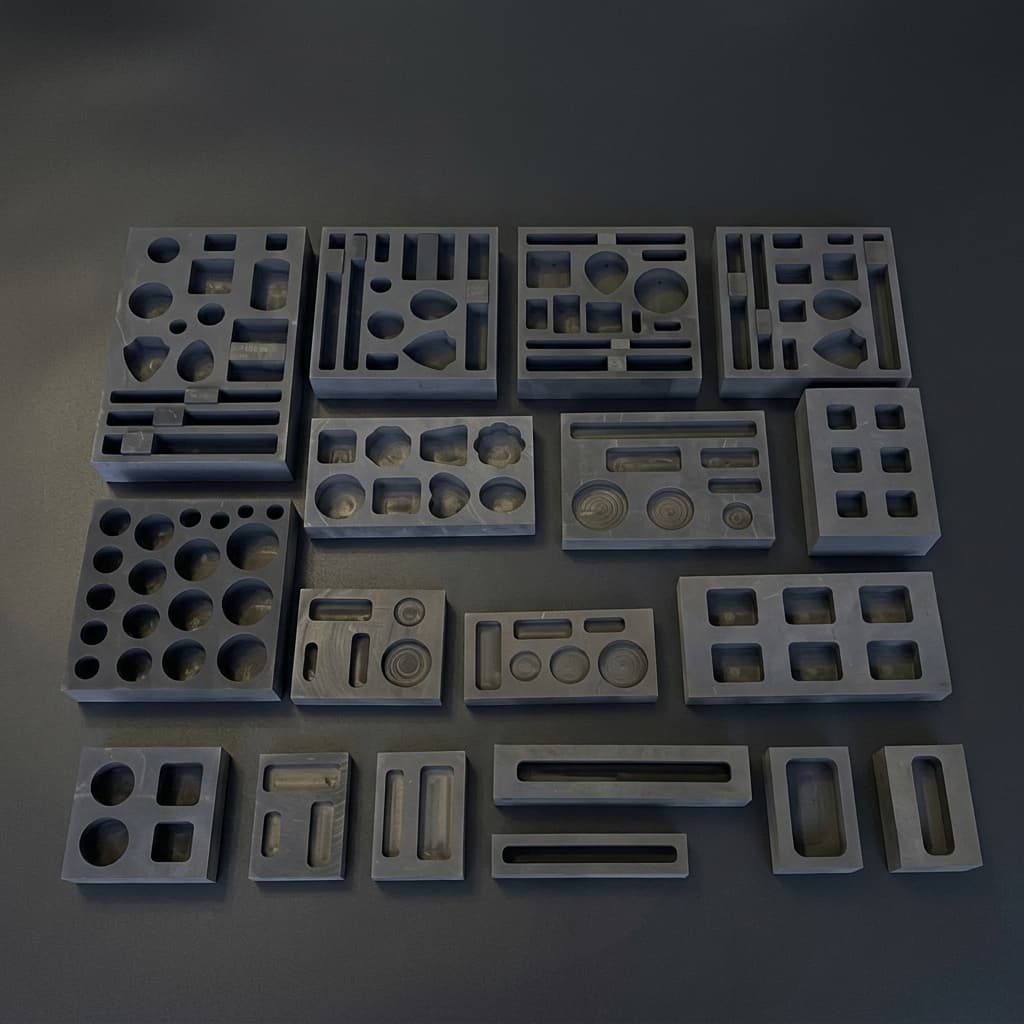
Carbon-Carbon (C/C) Composites vs. Isostatic Graphite: Vacuum Furnace Fixture Selection Guide
Compare C/C composites vs isostatic graphite for vacuum furnace fixtures: thermal mass, TCO, risks, checklist, and RFQ guidance from Custom Graphite Parts.
Decision-Level Conclusion: For vacuum furnace hot zones, isostatic graphite remains the cost-effective standard for heating elements, insulation supports, and many sacrificial components. However, for load-bearing fixtures, grids, and trays, Carbon-Carbon (C/C) composites can be a transformational upgrade. In tray and grid redesigns where fixture mass is the bottleneck, C/C composites can eliminate roughly 70% to 80% of fixture "dead weight," reducing thermal mass, shortening heating and cooling cycles, and creating long-term energy savings that can offset higher initial procurement costs.
As vacuum furnace technology advances to meet the stringent demands of aerospace brazing, medical implant sintering, and automotive gear hardening, the materials used inside the hot zone are under intense scrutiny. Procurement teams and metallurgical engineers constantly battle a hidden efficiency killer: fixture thermal mass.
Every kilogram of heavy steel, molybdenum, or thick monolithic graphite used to support the workload must be heated to extreme temperatures and then cooled back down. This wastes energy, extends cycle times, and reduces factory throughput. Today, the debate in high-temperature fixturing centers on two carbon-based options: High-Purity Isostatic Graphite and Carbon-Carbon (C/C) Composites (also known as CFC).
This guide dissects the mechanical, thermal, and economic realities of both materials to help you make a data-driven sourcing decision for your heat-treating operations.
Scope and limits, last reviewed July 25, 2026: this article is written for global procurement teams, furnace maintenance managers, and process engineers comparing load-bearing fixtures for vacuum, inert gas, brazing, sintering, and heat-treating furnaces. It is not a furnace OEM thermal model, material datasheet, or qualification protocol. Treat all strength, lifespan, cycle-time, and ROI ranges below as RFQ screening ranges that must be confirmed against the selected grade, weave architecture, coating, fixture drawing, support span, load map, atmosphere, contamination limits, and production recipe.
1. Material Science Basics: Understanding the Contenders
While both materials are fundamentally composed of carbon and can withstand temperatures exceeding 2,500°C in inert or vacuum environments, their microstructures dictate completely different mechanical behaviors.
What is Isostatic Graphite?
High-purity isostatic graphite is manufactured by compressing carbon powder and binders under equal pressure from all directions (isostatic pressing), followed by baking and graphitization at nearly 3,000°C.
- The Structure: It features a fine, uniform, and homogenous granular structure. It is highly isotropic, meaning its properties are identical regardless of the direction of measurement.
- The Flaw: Because it is a monolithic, crystalline material, it is inherently brittle. It lacks fracture toughness. To support heavy workloads (like steel gears or turbine blades), graphite fixtures must be designed with thick, bulky cross-sections to prevent cracking.
What are Carbon-Carbon (C/C) Composites?
C/C composites are advanced engineered materials originally developed for aerospace applications (like space shuttle heat shields and aircraft brake pads).
- The Structure: They consist of a carbon matrix reinforced with high-strength carbon fibers (either woven in 2D layers or 3D matrices).
- The Advantage: The continuous carbon fibers act as a structural skeleton. If a microscopic crack forms in the matrix, the carbon fibers arrest the crack, preventing catastrophic failure. This gives C/C composites immense tensile and flexural strength, allowing them to be machined into remarkably thin, lightweight, and durable structures.
2. The "Dead Weight" Penalty in Vacuum Furnaces
The most critical difference between graphite and C/C composites in fixturing applications is the strength-to-weight ratio.
When you use monolithic graphite to build a loading grid, the grid must be thick—often several inches, depending on span and load—to safely bear the weight of the parts at 1,200°C without bowing or snapping. This creates massive thermal mass in the vacuum furnace hot zone.
Consider a typical vacuum furnace run:
- Heating Phase: The furnace elements must pump electrical energy not just into the parts, but into the heavy graphite grid.
- Soaking Phase: The thick graphite grid absorbs heat slowly, extending the time required for the entire workload to reach thermal equilibrium.
- Cooling (Quenching) Phase: The most severe bottleneck. Gas quenching systems must extract heat from both the parts and the massive graphite fixtures. Heavy fixtures dramatically slow down the cooling rate, which can negatively affect the metallurgical microstructure (e.g., hardness) of the treated parts.
Because C/C composites are incredibly strong, a fixture that requires 3-inch thick graphite can often be replaced by a 0.5-inch thick C/C composite grid.
Visualizing the Cycle Time Impact
By replacing a 100kg graphite grid with a 20kg C/C composite grid, the furnace expends significantly less energy heating dead weight, and the quenching blowers can cool the actual parts faster. In furnaces where fixture mass and gas-flow blockage are the limiting factors, this can support a 20% to 30% total cycle-time reduction. Treat the chart as an illustrative screening model, not a guaranteed furnace result.
3. Comprehensive Property Comparison
To understand exactly why these materials behave differently, we must look at their fundamental engineering specifications. The following table highlights the critical differences between a premium grade of isostatic graphite and a standard 2D woven C/C composite.
| Property / Feature | Isostatic Graphite (Premium Grade) | Carbon-Carbon (C/C) Composite (2D) | Procurement & Engineering Impact |
|---|---|---|---|
| Flexural Strength | ~ 40 to 60 MPa | ~ 150 to 250 MPa | C/C is up to 5x stronger, allowing for incredibly thin, lightweight structural designs without sagging. |
| Fracture Toughness | Very Low (Brittle) | High (Fibrous Matrix) | Dropping a graphite tray usually shatters it. C/C composites resist impact and handling abuse on the shop floor. |
| Bulk Density | ~ 1.75 to 1.85 g/cm³ | ~ 1.50 to 1.65 g/cm³ | C/C is inherently slightly less dense, compounding weight savings when combined with thinner geometries. |
| Thermal Shock Resistance | Moderate to Good | Exceptional | C/C can withstand violently rapid quenching (e.g., 20-bar high-pressure gas quench) without propagating micro-cracks. |
| Maximum Operating Temp | Up to 3,000°C (Inert/Vacuum) | Up to 3,000°C (Inert/Vacuum) | Both materials remain stable far above standard heat-treat temperatures (1,000°C - 1,300°C) when oxygen exposure and contamination risks are controlled. |
| Initial Procurement Cost | Base Cost (1X) | Approx. 3X to 5X Base Cost | C/C requires complex, multi-month chemical vapor infiltration (CVI) manufacturing processes, driving up initial CAPEX. |
| Typical Lifespan (Fixtures) | 6 to 18 Months | 3 to 10 Years | C/C's resistance to thermal fatigue and handling damage can extend the replacement cycle, improving TCO when the fixture is correctly engineered. |
4. Total Cost of Ownership (TCO) and ROI
For procurement teams, the initial sticker shock of Carbon-Carbon composites is the primary barrier to entry. A graphite fixture that costs $1,500 might cost $6,000 if manufactured from C/C composite.
However, modern metallurgical procurement requires a Total Cost of Ownership (TCO) model. The ROI of upgrading to C/C composites is driven by three compounding factors:
- Increased Payload Capacity: If your furnace has a maximum weight limit of 1,000kg, and your graphite fixtures weigh 300kg, you can only process 700kg of parts. If you switch to C/C fixtures weighing 60kg, you can process 940kg of parts per cycle—a 34% increase in revenue-generating payload.
- Reduced Energy Consumption: Heating 240kg less "dead weight" every single day translates to massive electrical savings over a year.
- Extended Lifespan: Graphite grids often crack due to forklift mishaps, operator handling errors, or thermal fatigue after 12 months. C/C composite grids routinely last 5 to 7 years in the same environment. You will replace the graphite grid multiple times before the C/C grid shows significant wear.
For a first-pass RFQ model, estimate the payback window before comparing supplier quotes:
- Dead-weight reduction: old fixture mass - new fixture mass
- Added payload capacity: dead-weight reduction / usable furnace payload limit
- Energy impact per cycle: dead-weight reduction x estimated fixture heat capacity x temperature rise / furnace efficiency
- Throughput impact: current cycle time - qualified cycle time after fixture redesign
- Replacement impact: graphite fixture replacement count over five years - C/C fixture replacement count over five years
For most commercial heat treaters running 24/7 operations, the ROI on C/C fixtures is often screened in the 8 to 14 month range when higher payload, shorter cycles, and fewer replacements all apply. If your furnace runs low volume, has a fixed recipe that cannot be shortened, or already uses lightweight tooling, the payback window may be much longer.
5. When to Stick with Isostatic Graphite
Despite the mechanical advantages of C/C composites in load-bearing fixtures, monolithic isostatic graphite remains the better engineering choice in specific vacuum furnace zones.
You should not use C/C composites for:
- Heating Elements: Graphite has specific, tunable electrical resistivity. It remains the standard material for machining the actual heating elements (serpentine heaters, rods, and bands) that generate the furnace's heat.
- Hot Zone Insulation boards: Rigid graphite insulation boards and soft graphite felt are highly porous, reducing radiant and conductive heat loss. C/C is too dense and thermally conductive to serve as a primary insulator.
- Sacrificial Wear Plates: If you need a cheap, flat plate to protect the bottom of a hearth from molten brazing alloy drips, a standard graphite plate is much more cost-effective to replace than a C/C plate.
6. Engineering & Procurement Checklist: Upgrading to C/C Fixtures
If your engineering team is evaluating the transition from metallic (molybdenum/steel) or graphite fixtures to C/C composites, use this 7-point validation checklist before issuing a purchase order:
- 1. Furnace Payload Limits Checked: Calculate how much additional revenue-generating part weight you can fit in the furnace if the fixture weight is reduced by 70%.
- 2. Quench Rate Requirements Validated: Does your process require ultra-fast gas quenching (e.g., aerospace turbine blades)? Thinner C/C grids allow better gas flow and faster cooling rates.
- 3. Contact-Reaction Risks Assessed: Like molded and extruded graphite, C/C can react with certain alloys at high temperature if the workload directly contacts the fixture. Confirm alloy compatibility and use ceramic spacers (Alumina/Zirconia) when the furnace recipe or OEM guidance requires separation.
- 4. Workload Geometry Mapped: C/C allows for intricate, interlocking grid designs (egg-crate structures) without screws or bolts. Optimize the CAD design to take advantage of C/C's tensile strength.
- 5. Outgassing Parameters Confirmed: Ensure the C/C composite provider has fully baked/purified the material to prevent outgassing in high-vacuum environments.
- 6. Material Lead Time Budgeted: C/C manufacturing is a slow process (often involving months of vapor infiltration). Expect longer lead times for custom C/C fixtures compared to rapid CNC-machined graphite.
- 7. TCO Model Approved: Present management with an ROI calculation that includes energy savings, increased payload revenue, and a 5-year fixture replacement timeline.
7. Real-World Applications
- Aerospace Vacuum Brazing: The complex honeycomb structures of jet engine components require highly stable, flat surfaces during brazing. C/C composite trays do not warp or creep over time, ensuring tight tolerances are maintained batch after batch.
- Medical Implant Sintering (MIM): Metal Injection Molding (MIM) requires pure environments. C/C trays offer minimal contamination and the high thermal shock resistance needed for rapid turnaround of surgical instruments.
- Automotive Low-Pressure Carburizing (LPC): Oil quenching is brutal on fixtures. While standard graphite can absorb oil and crack under thermal shock, specialized coated C/C composites can withstand harsh LPC and oil-quench cycles when coating, cleaning, and qualification requirements are correctly specified.
8. Frequently Asked Questions (FAQ)
Does C/C composite warp at high temperatures like steel?
No. Unlike heat-resistant steel alloys (which suffer from high-temperature creep and distortion over time), Carbon-Carbon composites maintain their absolute dimensional stability up to 2,500°C. They will not sag or warp under load, provided they are engineered within their weight-bearing limits.
Can C/C composites be machined like graphite?
Yes, but they are much more abrasive. Machining C/C requires diamond-coated tooling and specialized dust extraction, similar to but more aggressive than standard graphite machining. The layered fibers can also splinter if improper feeds and speeds are used.
Do I need to coat C/C fixtures?
In standard inert gas (Argon/Nitrogen) or vacuum furnaces, no coating is required. However, if there is a risk of oxygen ingress at high temperatures, or if you are doing aggressive oil quenching, specialized anti-oxidation or silicon carbide (SiC) coatings can be applied to seal the porosity of the composite.
How do I join C/C composite parts together?
Due to its high strength, C/C is often assembled using interlocking joint designs (like mortise and tenon or egg-crate slots) that require zero hardware. When fasteners are necessary, specialized C/C threaded rods and nuts are used, as metallic fasteners would expand and crack the carbon matrix.
Are there different grades of C/C composite?
Yes. The most common for furnace fixtures is 2D woven C/C (layers of carbon cloth stacked and densified). For extreme structural applications (like aerospace nose cones), 3D woven C/C is used, providing isotropic strength across the X, Y, and Z axes, though it is significantly more expensive.
Elevate Your Furnace Operations with Custom Carbon Solutions
Transitioning your hot zone fixturing from heavy graphite or warping steel to advanced Carbon-Carbon composites is one of the highest-impact upgrades a commercial heat treater can make. The reduction in thermal mass directly translates to lower energy bills, faster cycle times, and increased profitability.
Whether you need replacement graphite furnace fixtures, hot-zone parts, or a complete redesign of your load-bearing grids using lightweight C/C composites, our engineering team is ready to assist.
Stop paying to heat dead weight. Contact us today for a technical consultation and RFQ to discover how optimized carbon fixtures can transform your vacuum furnace efficiency.
Sources / References
- Mersen: Carbon/Carbon Materials for Vacuum Furnace Refurbishing
- SGL Carbon: Graphite Products for High-Temperature Furnaces
- Thermal Processing Magazine: Increased Productivity: Combining C/C Fixturing and LPC
Author

Graphite CNC machining, EDM electrode, mold tooling, and export-aware sourcing specialists.
Categories
More Posts

Understanding Graphite Export Controls: What Global Buyers Need to Know in 2026
A practical guide to navigating China's export controls on high-purity and high-density artificial graphite. Learn how to secure end-user certificates, prevent supply chain disruptions, and manage lead times.
Mid-2026 Graphite Supply Chain Update: Section 301 Tariffs, EV Demand, and Sourcing Strategies
Mid-2026 graphite supply chain update for custom graphite buyers: Section 301 dates, EV demand, China-light sourcing limits, and RFQ actions.
Graphite Hot Zones for SiC Crystal Growth (PVT): Sourcing, Purity, and Machining Guide
Specify graphite hot zones for SiC PVT crystal growth: purity limits, GDMS evidence, machining risks, supplier questions, and RFQ steps for global buyers.