
Carbon Graphite Seals for Pump Service
Screen a pump-seal duty, build an inquiry brief, then compare material and assembly tradeoffs with traceable evidence.
Pump seal duty screen
Calculate ΔP × mean face velocity and prepare a drawing-review brief. Results update instantly on this device.
No duty summary yet
Enter differential pressure, mean face velocity, seal chamber temperature, or load an illustrative example.
Unknown values? Send the drawing and known process conditions for manual review.
For seal OEMs, pump reliability engineers and technical buyers. Published · Evidence reviewed · Publisher: Custom Graphite Parts (CGP). Next review by April 25, 2027, or sooner if a cited source changes.
Five decisions before specifying a carbon face
Evaluate the complete seal
A carbon face is one part of a system. Match the counterface, secondary seals, carrier and auxiliaries to the operating and upset conditions.
[S1][S2]Keep duty and rating separate
A pressure–velocity product describes an input duty. A material name or generic PV figure does not establish a tested operating envelope.
[S2]Reduce blistering risk across the system
Startup shear, fluid behavior and thermal cycles matter alongside porosity and impregnation. Antimony can help in compatible service; it does not eliminate the mechanism.
[S3]Treat cryogenic and dry service separately
Specialized grades and complete assembly qualification matter. General material-family claims cannot replace low-temperature or dry-gas evidence.
[S5]Define the component and its interfaces
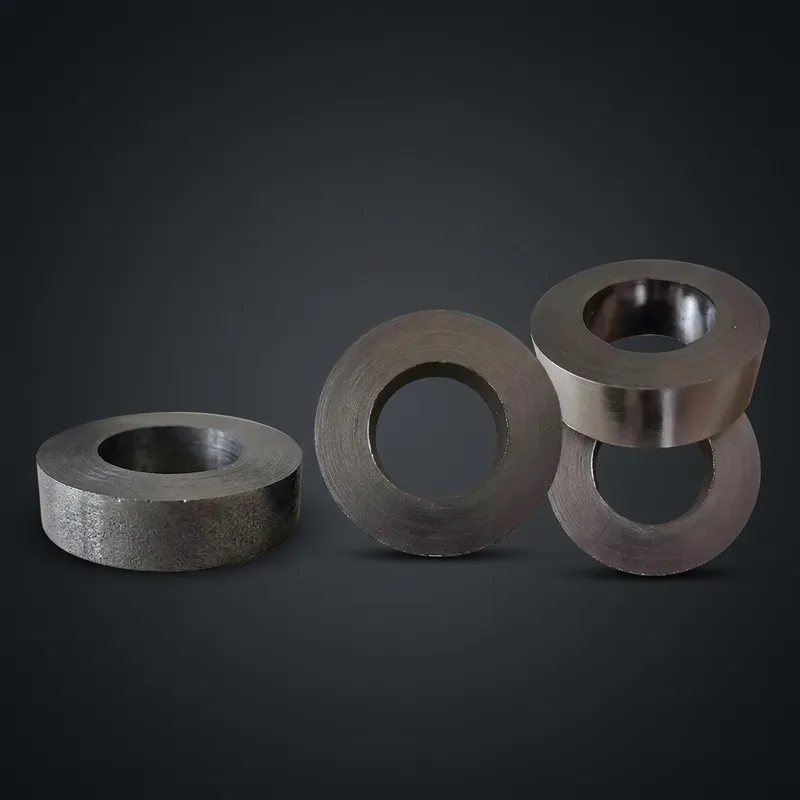
Product image for geometry context; no grade, qualification or dimensional capability is established by the photograph.
Scope this RFQ as a primary face ring, a ring retained in a carrier, or a complete cartridge. This page supports face-ring sourcing and the questions to take to your seal designer. A bare ring quotation cannot establish performance of a complete cartridge. [S1][S2]
Looking for radial support rather than face sealing? Use the pump bearing duty guide or bushing fit and PV tool.
Reproduce the calculation and understand its limits
The tool uses I = ΔP × V, with ΔP in bar and V at the mean seal-face diameter in m/s. For an annulus, Dm = (OD + ID) / 2 and V = π × Dm × RPM / 60 with Dm in metres. This is a kinematic and unit-conversion calculation, independent of a carbon-grade model.
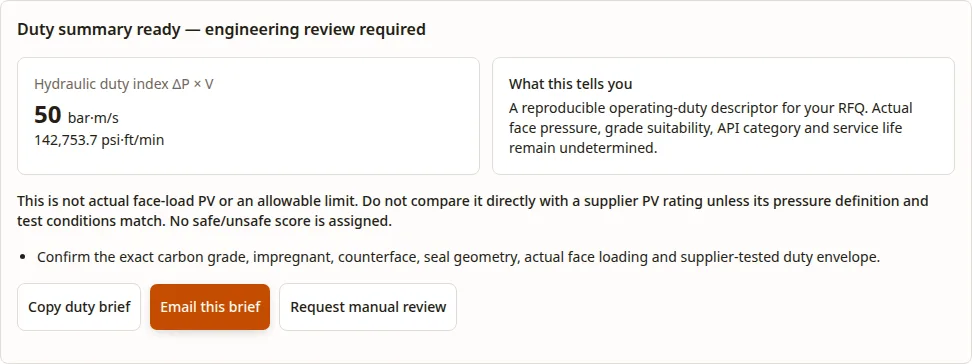
Worked example: OD 80 mm, ID 40 mm and 1,800 RPM give Dm = 60 mm and V ≈ 5.655 m/s. At ΔP = 10 bar the index is approximately 56.55 bar·m/s. The tool’s simplified Water example instead uses a stated V of 5 m/s and gives exactly 50 bar·m/s, approximately 142,754 psi·ft/min.
| Item | What the tool knows | What remains unresolved |
|---|---|---|
| Duty index | User-entered differential pressure and mean face velocity | Actual contact pressure and allowable face-load PV |
| Temperature | User-entered bulk seal chamber temperature | Local face temperature, flash margin and heat removal |
| Material | Fluid family and qualitative review questions | Exact grade, impregnant, compatibility and qualification |
| Compliance / life | No qualification data supplied | API classification, leakage, service life and acceptance |
Method: 1 bar = 100,000 Pa; 1 psi ≈ 6,894.757 Pa; 1 ft = 0.3048 m. The conversion factor is approximately 2,855.074. Tool bounds are input constraints, not equipment limits.
Face balance, fluid pressure distribution and spring loading require actual geometry and operating conditions. This tool does not invent those values, calculate frictional power or rank a duty as safe. If mean face velocity or pressure is unknown, send the drawing and process data for manual review.
Compare grade families without transferring ratings
| Family | Reason to discuss | Required checks / tradeoff |
|---|---|---|
| Resin-impregnated carbon | Impermeability and chemical-service options | Exact resin, cure, residual porosity, temperature and fluid compatibility; blistering response is grade specific. |
| Antimony / metal-impregnated carbon | Potential blister resistance and thermal-property benefits | Metal compatibility, contamination limits and qualification. Do not assume zero blistering or universal hot-water suitability. |
| Other impregnants, including PTFE | A candidate where the exact supplier grade matches the fluid | No universal pH, temperature or food approval follows from the impregnant name. Obtain the actual grade data. |
| Carbon-bonded / electrographite grades | Specialized thermal or atmosphere duties | Permeability, strength, lubrication and thermal cycling vary; a resin-free label does not qualify cryogenic service. |
Supplier selection literature describes its own grades. Published properties, temperature ceilings and approvals must be checked for the supplied material and conditions. Sources: [S2][S3][S5]
For corrosive pumps, provide the actual chemical mixture and cleaning cycle. A pH band cannot represent oxidizing strength, contaminants or binder attack. Review chemical-service graphite compatibility questions alongside the seal OEM’s material review.
Prepare a seal-ring RFQ packageSpecify the mating face and the full wetted system
| Candidate | Specify on the drawing / data sheet | Decision boundary |
|---|---|---|
| Silicon carbide | Exact grade, manufacturing route, free silicon and surface finish | Compatibility and thermal behavior are grade specific; do not treat all SiC as interchangeable. |
| Tungsten carbide | Binder composition, grade, corrosion data and finish | Binder and fluid compatibility must be verified together. |
| Other hard faces | Exact ceramic / coating and supplier evidence | No generic PV limit is assigned; obtain paired-material test data. |
| Secondary seals and carrier | Elastomer or wedge material, metal alloy, fit and exposure | Face compatibility alone cannot qualify the assembled seal. |
Buyer checklist synthesized from the cited selection literature. It is not a material ranking or a substitute for paired-face testing. Sources: [S2][S5]
For solids-laden service, ask the seal OEM whether a hard-on-hard pair, a different chamber arrangement or a clean external flush is more appropriate. Review abrasion, lubrication and process dilution together; no universal solids-percentage cutoff is asserted here.
Blistering: combine material, startup and fluid review
The January 2026 FSA/Metcar article identifies startup shear, fluid behavior and thermal cycling as interacting causes. It describes better resistance from appropriate low-porosity and metal-impregnated grades, alongside face design, heat removal and operating controls. Treat impregnation as one part of mitigation. [S3]
Ask for cold-start viscosity and traction data, stop/start frequency, the condition of the mating face, actual flush conditions and returned-face photographs. If damage is present, preserve the ring and operating history for root-cause review rather than selecting a harder grade from the appearance alone.
Dry gas, cryogenic and sanitary service need separate evidence
Low-temperature guidance is not uniform across generic material families. AESSEAL discusses specialized carbon formulations and application-specific counterfaces; this contradicts blanket claims that all resin-containing grades are unsuitable or that SiC is always preferred in cryogenic duty. Use the actual qualified grade and complete assembly evidence. [S5]
Record gas composition, dew point, vacuum level, chilldown sequence and the availability of a liquid film. No universal −30°C dew-point failure threshold or dry-running time is established here. A process change such as moisture addition needs review for contamination and process compatibility.
For potable water, food and pharmaceutical service, request the exact material declaration and applicable intended-use conditions for all wetted parts. AESSEAL’s low-temperature guide excludes antimony-impregnated carbon from food and pharmaceutical service. Keep that exclusion in the material review; carbon, resin or PTFE labels alone do not approve an alternative grade. [S5]
Carrier fit, brittle features and thermal mismatch
For a linear, uniform-temperature estimate, differential diametral growth is D × (αcarrier − αring) × ΔT. This describes geometric mismatch only; it does not solve contact pressure, hoop stress or retained fit. Obtain temperature-dependent expansion and elastic data for the exact grade and alloy.
Do not choose 316L, a nickel alloy or titanium from operating temperature alone. Review ring section thickness, carrier wall, assembled interference, anti-rotation features and the entire thermal cycle. Specify radiused slots, edge protection and an agreed inspection state to reduce brittle-feature and handling risk. The assembly drawing is required before a retention conclusion.
For component machining, optical lapping tolerances, and RFQ specifications, review our carbon graphite seals manufacturer capabilities, carbon graphite wear parts and inspection and traceability requirements.
Make flatness acceptance reproducible
| Requirement | Record explicitly | Why it matters |
|---|---|---|
| Flatness | Agreed band limit or dimensional tolerance, active sealing area | No generic API band count is assigned by this guide. |
| Light source | Actual wavelength and optical-flat calibration | One band = λ/2; at illustrative λ = 589 nm, one band = 0.2945 µm. |
| Support / assembly state | Bare ring or mounted assembly; fixture and temperature | Support weight and assembly strain can distort slender carbon rings. |
| Surface condition | Agreed roughness, permitted defects, cleaning and reference method | Flatness and roughness are different measurements. |
| Inspection record | Part revision, lot, method and accepted results | Tie evidence to the supplied ring and its assembly condition. |
Lapmaster describes fringe curvature as deviation from a reference. The initial pattern alone does not establish the sign of curvature. Numeric acceptance limits must come from the reviewed specification. Sources: [S6][S7]
Distinguish flush, buffer, barrier and quench functions
| Plan | Function | Question before selection |
|---|---|---|
| 11 | Pump-discharge product recirculation to the seal | Is product quality and pressure margin suitable? |
| 23 | Seal-chamber recirculation through a heat exchanger | Can the designed loop remove heat and circulate in all required states? |
| 32 | External liquid flush into the seal chamber | Is process dilution acceptable and is the external liquid compatible? |
| 52 | Unpressurized buffer circulation for a dual seal | Does this arrangement provide the required containment? |
| 53A / 53B / 53C | Pressurized barrier systems with different pressure-support designs | What pressure control, monitoring and utilities are required? |
| 54 | Externally pressurized barrier liquid circulation | Is the dual-seal arrangement designed for this barrier system? |
| 62 | Atmospheric-side quench | Is the quench compatible with product and the seal design? |
Functional summary of AESSEAL’s published plan index, reviewed October 25, 2026. These are distinct systems, not automatic recommendations triggered by pressure or fluid labels. Sources: [S4]
Five illustrative reviews: premises, process and next decision
Engineering exercises only. These are not CGP customer case histories, test results, lifetime predictions or delivery commitments.
Hot-water pump
Premise: 40 bar, 18 m/s, 140°C; liquid film intended.
Review: Index = 720 bar·m/s. Review local flash margin, startup history and heat removal; discuss grade and support loop together. [S3, S4]
Next decision: Hold material approval pending the reviewed grade and seal-system data.
Chemical-transfer pump
Premise: 12 bar, 12 m/s, 45°C; exact acid concentration not supplied.
Review: Index = 144 bar·m/s. Obtain mixture, impurities and cleaning data; check impregnant, counterface and secondary seals. [S2]
Next decision: Prepare a compatibility review rather than selecting from pH alone.
Cryogenic transfer
Premise: 25 bar, 22 m/s, −160°C; lubrication during chilldown unknown.
Review: Index = 550 bar·m/s. Review gas exposure, thermal contraction and exact grade/assembly qualification. [S5]
Next decision: Request low-temperature evidence; do not prescribe generic resin-free carbon or SiC.
Hydrocarbon cold start
Premise: 35 bar, 20 m/s, 65°C; cold-start viscosity not supplied.
Review: Index = 700 bar·m/s. Running bulk temperature does not describe startup traction, volatility or local heat removal. [S3]
Next decision: Request fluid and startup data before comparing candidate grades.
Dry-gas standby
Premise: 5 bar, 8 m/s, 25°C; dry nitrogen at the faces.
Review: Index = 40 bar·m/s. The small index does not qualify dry contact or predict wear. Record gas, dew point and contact conditions. [S5]
Next decision: Seek a specifically qualified dry-service grade and system review.
Failure symptoms, cost risks and alternatives
| Observation / risk | Check before concluding | Mitigation / alternative |
|---|---|---|
| Raised patches / pits | Startup, fluid traction, thermal cycles and face condition | Review grade and fluid management together; preserve failed parts. [S3] |
| Leak after mounting / heat cycle | Carrier fit, fixture effects, distortion and secondary seals | Inspect the agreed assembly state; revisit geometry and retention model. [S6] |
| Black debris in dry gas | Exact grade, atmosphere, contact and transient history | Request dry-service evidence; consider a seal design qualified for the gas. [S5] |
| Procurement cost | Grade qualification, tooling, inspection and documentation scope | Compare total reviewed assembly cost; agree prototype and acceptance scope before production. |
| Wrong service / component scope | Abrasive slurry, radial bearing duty or complete cartridge need | Ask the OEM about hard-on-hard pairs, flush strategy, bearing tooling or a complete seal supplier. |
Symptoms do not prove a root cause. The procurement and assembly questions are this guide’s qualitative engineering checklist, without claimed probabilities or savings. Sources: [S3][S5][S6]
Trace the evidence and its limits
Sources were reviewed on . Primary supplier and association references support the selection questions above. Their published grade data do not certify CGP materials. Licensed API clause text and CGP duty-test reports were not available for this page; API compliance, allowable PV, leakage, wear and service life remain undetermined.
[S1] API — 2024 Publications Catalog, STD 682 entry
Catalog p. 100 (PDF p. 104): edition 4, May 2014; reaffirmed May 2022
Official scope and classification record. This page does not reproduce licensed clauses or certify an assembly.
[S2] Mersen — Carbon & Graphite Solutions for Mechanical Applications
Undated supplier brochure, PDF p. 4; accessed October 25, 2026
Material families, impregnation and sealing-ring selection. Mersen grade ratings cannot be transferred to an unspecified CGP grade.
[S3] Fluid Sealing Association / Metcar — Carbon-Graphite Blistering in Mechanical Seal Faces
January 2026, pp. 40–41; Mike Clevenger
Startup shear, fluid properties and thermal cycling contribute to blistering. Lower porosity and appropriate impregnation can reduce risk; no elimination guarantee.
[S4] AESSEAL — API Piping Plans
Undated live reference; accessed October 25, 2026
Functional distinction between process flush, buffer and barrier systems. Final selection requires system design.
[S5] AESSEAL — Cryogenic and Low Temperature Applications
Copyright 2025, pp. 8–9; accessed October 25, 2026
Fluid- and grade-specific cryogenic considerations, including specialized carbon grades. Does not support a blanket resin ban or universal SiC selection.
[S6] Lapmaster Wolters — Optical Flats
Undated method reference; accessed October 25, 2026
Fringe interpretation, measurement setup and distortion-sensitive parts. Curvature alone does not distinguish convex from concave.
[S7] Lapmaster Wolters — Monochromatic Light
Undated equipment reference; accessed October 25, 2026
One light band is half the source wavelength. Use the actual lamp specification for conversion.
Questions for seal engineers and technical buyers
Duty and selection
What does the pump seal duty calculator calculate?
It multiplies sealed differential pressure in bar by mean seal-face velocity in m/s and converts the product to psi·ft/min. It also creates a review brief. Actual face contact pressure, frictional heat, material suitability and API compliance are not calculated.
Is the displayed duty index an allowable PV limit?
No. The tool uses sealed differential pressure. A supplier may define PV using actual face load and specific test conditions. Obtain the exact definition, grade, counterface, fluid, temperature and test method before making any comparison.
How do I get mean face velocity from RPM?
For an annular face, mean diameter Dm = (face OD + face ID) / 2. V = π × Dm × RPM / 60, with Dm in metres. The shaft diameter alone is insufficient. At 60 mm mean diameter and 1,800 RPM, V is approximately 5.655 m/s.
Can this tool choose an API 682 category or material code?
No. API 682 addresses the seal system. Category, type, arrangement, materials, testing and auxiliaries must be agreed against the applicable edition and purchase specification with the seal OEM.
Materials and difficult service
Should I choose resin or antimony impregnation?
Treat them as candidate families. Resin chemistry, metal compatibility, porosity, thermal properties and service conditions differ by grade. Antimony-impregnated grades can improve blister resistance in suitable service, but do not eliminate blistering or establish chemical compatibility.
Are carbon graphite seals suitable for acids and alkalis?
Some grades are, but pH alone cannot establish compatibility. Provide the chemical identity, concentration, impurities, temperature and cleaning cycle. Verify the impregnant, counterface and its binder, carrier and secondary seals separately.
Can I use a standard carbon face in dry gas or vacuum?
Do not infer dry-running capability from a carbon label. Request a grade qualified for the actual gas, dew point, contact load and speed. There is no universal dry-running duration or dew-point threshold stated on this page.
Does cryogenic service always need resin-free graphite and SiC?
No. AESSEAL describes specialized carbon grades for low-temperature conditions and cautions that counterface selection is application specific. Confirm fluid, chilldown, gas exposure and full-assembly qualification with the seal designer.
Does PTFE impregnation establish food or potable-water approval?
No. Obtain the exact grade declaration, intended-use conditions and documentation for all wetted components. Generic carbon or PTFE descriptions do not establish compliance for an assembled seal.
Assembly, inspection and RFQ
How many optical light bands should the seal drawing specify?
Agree the acceptance limit and test method with the seal OEM. Band height is half the actual light-source wavelength; at an illustrative wavelength of 589 nm, one band is 0.2945 µm. This conversion is not an API acceptance criterion.
Can shrink-fit retention be selected from temperature alone?
No. Carrier and ring geometry, interference, elastic properties, expansion data, assembly temperature and the operating cycle all matter. Differential expansion is a screening input; it does not calculate retention stress or prove a carrier alloy suitable.
Are Plan 32 and Plan 54 the same external flush?
No. Plan 32 supplies an external liquid flush to the seal chamber. Plan 54 circulates a pressurized external barrier liquid in a dual-seal system. Confirm arrangement, pressure, fluid compatibility and utilities with the seal OEM.
What should I send for a drawing-based quote?
Send a revision-controlled drawing, exact or proposed grade, impregnant, fluid data, normal and upset pressure/temperature, mean face velocity or face dimensions and RPM, counterface, seal arrangement, inspection requirements, quantity and destination. Attach PDF/STEP files manually to the inquiry.
Can I get a guaranteed life or fixed delivery time from this page?
No. Life, leakage, price and lead time need a reviewed specification, grade availability, production and inspection plan. The scenarios on this page are illustrative engineering exercises, not measured CGP customer results.
Turn the duty brief into a drawing-based RFQ
| Package | Include | If unknown |
|---|---|---|
| Controlled drawing | Revision, OD/ID, face width, tolerances, drive features and carrier | Send an annotated sketch or existing part documentation. |
| Material / counterface | Exact carbon grade, impregnant and hard-face grade/binder | State existing markings; ask for candidate review. |
| Fluid | Identity, concentration, contaminants, solids and vapor/viscosity data | Identify the process and provide the available data sheet. |
| Operating envelope | Normal/startup/upset pressure, temperature, speed, gas exposure and cycling | Clearly mark missing conditions; include known values. |
| Assembly / support | Seal arrangement, secondary seals, carrier fit and existing support plan | Provide the seal OEM model or assembly drawing. |
| Inspection / packing | Agreed flatness method, roughness, leak tests if specified and face protection | Ask for a proposed inspection and contamination-compatible packing plan. |
| Commercial scope | Prototype/production quantity, destination, documents and required date | Request a feasibility review before committing a schedule. |
Attach PDF/STEP drawings manually. Quote scope, material availability, inspection and destination requirements determine price and lead time; no fixed production promise is made here.
The duty brief helps identify missing information. Ask the seal OEM to confirm geometry, grade, fit and acceptance requirements before production. Protect lapped faces individually during shipment and agree packing materials compatible with the intended process.
Copy the visible tool brief into your email or the contact form and attach drawings manually. Missing a parameter? Send the known conditions to [email protected] for manual review.