
Resin-Impregnated vs. Antimony-Impregnated Carbon-Graphite for Mechanical Seals and Pump Bearings: Engineering Selection & RFQ Guide
Compare resin vs antimony impregnated graphite for seals and pump bearings. Check grade data, blistering risks and service limits, then prepare a complete RFQ.
Selection answer: Resin-impregnated vs. antimony-impregnated carbon-graphite is a grade-and-service decision. Resin grades are candidates where their chemical compatibility and metal-content profile suit the process. Antimony grades can offer better blister resistance and higher temperature or load capability in selected duties. Neither impregnant alone establishes chemical compatibility, dry-running survival, API 682 conformity, or food/drinking-water acceptance.
This guide helps pump OEM engineers, reliability teams, seal rebuilders, and MRO buyers compare materials for mechanical seal faces and liquid-lubricated pump bearings. Start with the fluid, temperature, loading, mating material, and required documentation; then compare named grades.
Use our graphite grade comparison for the wider material families. Here, the useful procurement output is a shortlist with unresolved conditions recorded, rather than an automatic substitution between resin and antimony.
Published and reviewed: October 26, 2026. Scope: Global, English-language engineering and procurement guidance. Applications are seal rings, sleeve bearings, and bushings. Material temperature data are not assembled-pump ratings; qualification must include lubrication, atmosphere, counterface, fits, and transient conditions. This article does not establish regulatory approval or a dry-running limit.
Comparison method: We compare named manufacturer grades and a trade-association failure guide, then translate the differences into RFQ questions. Published third-party properties are identified below. The worked calculation is illustrative arithmetic, not a physical test or a customer case study. No factory test data, certification, or service-life result is claimed.
Have a replacement drawing? Request a seal or bearing material review with the existing grade, fluid, operating conditions, and failure history.
1. The Porosity Dilemma: Why Carbon Must Be Impregnated
Carbon-graphite bodies can retain connected pores after manufacture. Impregnation fills accessible pores to reduce bulk permeability and modify mechanical behavior. Carbon-graphite, electrographite, and resin-bonded carbon are distinct material families; their heat treatment and properties should not be treated as interchangeable.
For a seal ring, distinguish leakage through the carbon body from leakage between the running faces. Impregnation can address the former; face geometry, loading, lubrication, and thermal distortion still control the latter. A bearing also needs the correct clearance and fluid supply, even when its material has low permeability.
Do not translate “impregnated” into “zero porosity.” Specify a measurable finished-part leak criterion, test medium, pressure, duration, and acceptance rate.
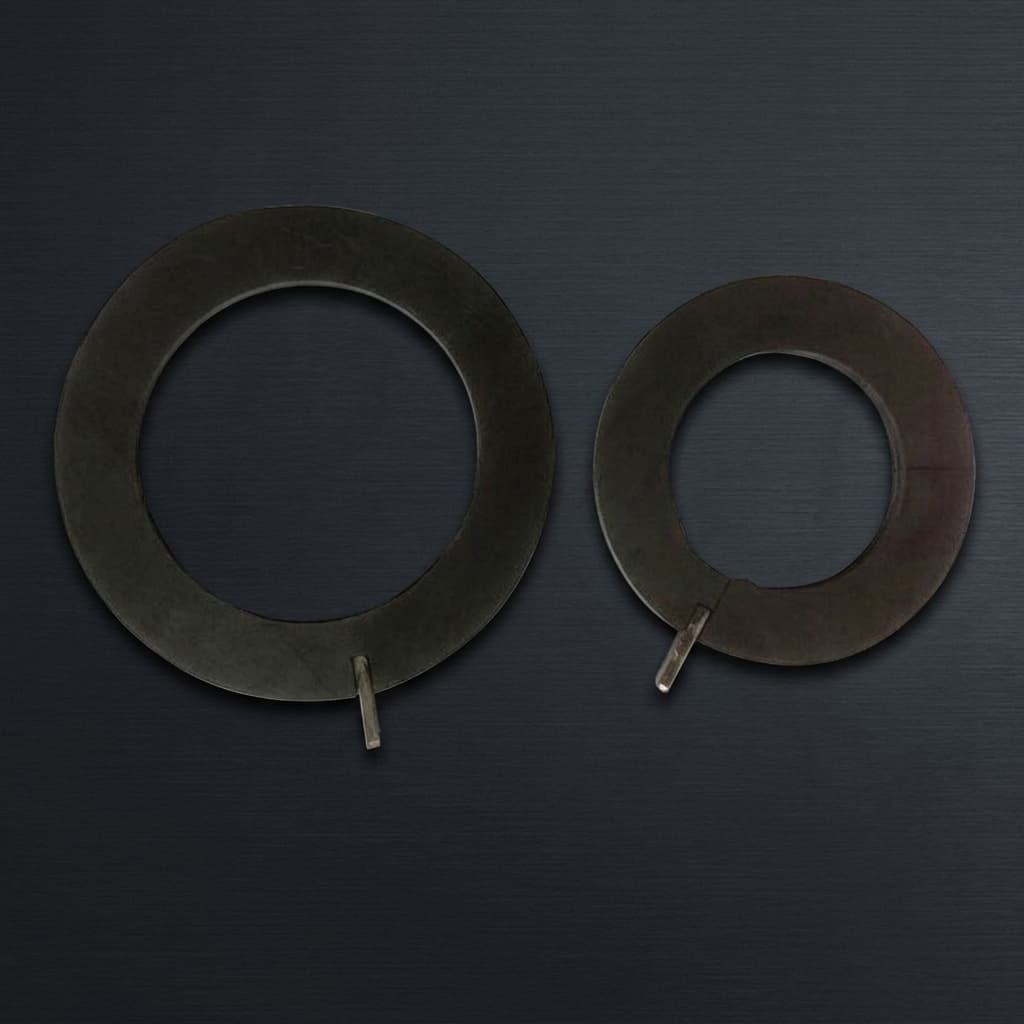
Ring geometry illustration. Appearance alone cannot identify the impregnant or establish performance.
2. Microstructural Differences: Resin Shrinkage vs. Antimony Expansion
The impregnant changes pore filling, but the base carbon structure remains a major influence on strength, heat transfer, expansion, and wear.
A. Resin-Impregnated Carbon-Graphite
Resin is introduced into accessible pores and cured. Its chemistry and cure affect residual porosity, temperature capability, and fluid compatibility. Resin shrinkage can contribute to residual voids, but a resin grade is not automatically unsuitable for all hydrocarbons. Ask for the exact resin/grade and documented service limits.
B. Antimony-Impregnated Carbon-Graphite
Molten antimony fills accessible pores. Expansion during solidification can reduce residual porosity and improve blister resistance, as described by the Fluid Sealing Association's January 2026 article. That mechanism does not prove complete impermeability or immunity to blistering. Chemical exposure and permitted metal content remain separate selection gates.
3. Carbon Blistering: Material and System Effects
Blistering can involve startup shear, subsurface fluid vaporization, and thermal cycling. A useful diagnosis reviews the operating history and seal system alongside the face material; it should not assume every pit has one cause.
What to Check After a Blistering Failure
Record fluid viscosity and temperature at startup, start/stop frequency, vapor-pressure margin, flush conditions, and damage on both faces. The FSA guide describes startup traction and thermal effects alongside fluid ingress; changing impregnant alone does not remove those causes.
The API Standard 682 Perspective
API Standard 682, fourth edition addresses pump shaft sealing systems, not a stand-alone approval of any antimony blank. Specify the contract edition, seal configuration, support system, material designation, and required qualification evidence with the seal vendor. This article does not reproduce or establish clause-level material mandates from the licensed standard.
4. Grade-Specific Engineering Comparison
The table compares Schunk FH42Z2 / FH42ZH2 resin grades with FH42A antimony carbon from Characteristics standard materials, printed pages 2–4. These are third-party examples, not specifications for parts supplied by Custom Graphite Parts or evidence of grade equivalence.
| Published property | FH42Z2 / FH42ZH2, phenolic resin | FH42A, antimony | Procurement interpretation |
|---|---|---|---|
| Bulk density, g/cm³ | 1.75 | 2.30 | Density alone cannot identify or qualify a replacement. |
| Flexural strength, MPa | 60 | 80 | Review thin sections and assembly loads. |
| Compressive strength, MPa | 210 | 250 | A material property is not an allowable pump pressure. |
| Young's modulus, GPa | 18 | 24 | Include stiffness in the face-deflection review. |
| Thermal conductivity, W/(m·K) | 11 | 13 | Heat transfer depends on the base grade as well as impregnant. |
| Thermal expansion, 20–200°C, 10⁻⁶/K | 4.6 | 4.2 | Source orientation: perpendicular to pressing direction. |
| Temperature limit, oxidizing atmosphere, °C | 200; 260 for ZH2 | 350 | Confirm the actual grade and the service environment. |
| Temperature limit, inert atmosphere, °C | 200; 260 for ZH2 | 600 | An atmosphere limit does not establish a wet-service rating. |
Data boundary: Schunk labels its properties as typical, subject to variation, and not guaranteed. Its nomenclature distinguishes standard phenolic resin from the higher-temperature ZH version. Neither column supplies a universal wet or dry PV limit. Use the current supplier datasheet and the assembled equipment's approved operating envelope before substitution.
For these particular grades, antimony carbon is only about 1.18 times as thermally conductive as resin carbon (13 ÷ 11). This reproducible comparison shows why “antimony is always three times more conductive” is an unreliable purchasing rule. Different base carbons can change the comparison substantially.
5. Pressure-Velocity Screening for Seals and Pump Bearings
A PV value is meaningful only when pressure, speed, lubrication, temperature, and test geometry use the same definitions as the supplier's rating. Do not transfer a seal-face limit to a carbon-graphite sleeve bearing.
For an initial radial sleeve-bearing calculation:
- Projected bearing pressure: P = F / (d × L), with load F in N and journal diameter d and bearing length L in mm; the result is N/mm², equal to MPa.
- Surface speed: V = π × d × n / 60, with d in metres and rotational speed n in rpm; the result is m/s.
- PV: multiply P in MPa by V in m/s.
Illustrative RFQ calculation: A 25 mm journal, 40 mm bearing length, 1,200 N radial load, and 1,450 rpm give a projected area of 1,000 mm², P = 1.20 MPa, V = 1.90 m/s, and PV ≈ 2.28 MPa·m/s. This is a demand estimate, not a pass/fail result. Provide the fluid viscosity at operating temperature, clearance, lubrication path, startup frequency, and upset duration before comparing it with a tested grade limit.
For a mechanical face seal, ask the seal vendor to establish effective face loading and sliding speed at the running track. Pump discharge pressure and shaft surface speed cannot simply replace those quantities. Face balance, springs, fluid-film behavior, and heat removal affect the result.
Friction and Dry-Running Boundaries
Treat friction coefficients and dry-running capability as test-condition data. A material temperature limit does not specify how long a wet seal or bearing survives loss of liquid. Require explicit supplier/OEM approval for any dry-start or run-dry condition, plus the intended protection or shutdown response.
6. Chemical Compatibility: Avoid Family-Level Shortcuts
Assess the base carbon, impregnant, counterface, secondary seals, and metal holder against the complete fluid composition. Concentration, temperature, contaminants, cleaning chemicals, and exposure duration matter; pH alone is insufficient.
Acid and Oxidizing Service
A resin grade may be a candidate for acid-resistant graphite components, but neither “resin” nor “graphite” establishes universal acid or oxidizer resistance. For antimony carbon, require a grade-specific compatibility statement that addresses the metal as well as the carbon. Do not assume every mineral acid attacks antimony at the same rate, or that a generic reaction equation predicts field life.
Solvents, Amines, and Caustics
Request compatibility and dimensional-stability evidence for the exact resin when swelling or softening could consume bearing clearance. An antimony grade may be an alternative, but it still needs confirmation for the specified fluid and conditions. Include hot cleaning and steam-out cycles in the review.
Practical decision: If compatibility evidence is missing, keep the material choice open. Agree on representative exposure testing and acceptance criteria with the supplier and equipment owner before approving a replacement.
Need help defining that evidence? Send the fluid specification and drawing for an RFQ review, including the current grade and cleaning cycle.
7. Food, Drinking-Water, and Environmental Documentation
For food, pharmaceutical, or drinking-water contact, specify the destination market, actual contact conditions, and required approvals before requesting a grade. Neither “resin-impregnated” nor “antimony-impregnated” is a compliance certificate. Do not infer a blanket legal ban, exemption, or certification from the material family name.
NSF's explanation of NSF/ANSI/CAN 61 describes health-effects evaluation of drinking-water materials and components. When certification is required, request the listing and verify that it covers the supplied product, material, and intended use. A bulk drinking-water concentration limit is not a substitute for the applicable component evaluation.
For a specified FDA food-contact requirement, ask for the applicable regulatory basis and a declaration covering the exact formulation and use conditions. For a specified RoHS/REACH requirement, obtain a current, product-specific declaration with its scope stated. This guide establishes no legal determination, and claims no certification for Custom Graphite Parts grades.
8. Mating Face and Bearing Assembly Compatibility
Compare the carbon grade with the exact counterface grade, finish, geometry, and loading. “Silicon carbide” and “tungsten carbide” describe families; manufacturing route, free silicon, and binder composition can change the compatibility review.
- Mechanical seal faces: Identify the SiC or carbide grade and supplier. Agree on flatness, roughness, measurement method, and mounted-condition requirements with the seal designer rather than imposing one finish on every service.
- Sleeve bearings: Identify journal material and finish, operating clearance, alignment, grooves, cooling path, and solids exposure. Check the assembled clearance after press fitting and at operating temperature.
- Holders and fits: Review thermal expansion and interference together. Increasing material strength cannot compensate for an unsuitable fit, edge geometry, or thermal gradient.
A practical first-article review checks the mounted component and its documentation against the approved drawing before service qualification.
9. Engineering Selection and RFQ Checklist
Use this checklist to make a material recommendation reviewable and a quote comparable:
- 1. Part identity: Drawing revision, application, existing manufacturer/grade, requested interchangeability, quantity, annual demand, and destination.
- 2. Fluid exposure: Full composition, concentrations, pH where relevant, viscosity at operating temperature, solids, contaminants, and cleaning/CIP chemicals.
- 3. Temperature and pressure: Normal and maximum conditions, startup/shutdown, upset duration, steam-out, seal-chamber pressure, and atmosphere where relevant.
- 4. Loading and lubrication: Speed, radial load or effective seal-face loading, PV calculation with definitions, fluid supply, support/flush arrangement, and credible dry-running events.
- 5. Geometry and mating parts: ID/OD, length, counterface or journal grade, fits, clearances, flatness/roughness requirements, datum scheme, and inspection method.
- 6. Approval evidence: Grade datasheet, chemical-compatibility statement, required food/water or environmental declarations, and any API 682 contract requirements with the seal vendor's evidence.
- 7. Acceptance and supply: Agreed finished-part leak-test method and numerical acceptance criterion, dimensional report, traceability, first-article/service qualification, stock status, and confirmed lead time.
Do not specify a universal proof-test multiplier or “zero leakage” without a defined method, detection limit, and equipment-owner approval. Separate routine part inspection from qualification of the operating seal or bearing system.
10. Frequently Asked Questions
Q1: How does blistering differ from abrasive wear?
Blistering can start as raised, shiny patches and progress to fractured pits; abrasive wear may show grooves in the sliding direction. Photograph both faces and preserve the operating history. Surface appearance is a diagnostic clue, not proof of the underlying cause. The FSA failure guide, pages 40–41 illustrates blister development.
Q2: Is antimony carbon always the better replacement?
No. Better blister resistance in a suitable duty does not resolve chemical compatibility, permitted metal content, fit, or system qualification. Compare named grades and seek written approval for substitution.
Q3: Can resin-impregnated carbon be used in steam service?
Some grades are intended for steam-related applications, but there is no universal resin cutoff that qualifies every seal. Confirm the actual steam/condensate conditions, cleaning cycles, pressure, mating materials, and supplier/OEM limits. A material's inert-atmosphere temperature rating does not establish steam suitability.
Q4: Will antimony impregnation prevent a magnetic-drive pump bearing from seizing?
No. Loss of lubrication, incorrect installed clearance, debris, misalignment, thermal changes, or incompatible chemistry still require investigation. Review the complete pump-bearing duty and protection scheme; do not assume a material change permits cavitation or dry running.
Q5: Should the drawing use the same tolerances for both materials?
Functional requirements come first. Confirm that the proposed grade, machining sequence, impregnation stage, and mounted inspection can meet them. Our graphite CNC machining design guide explains general design trade-offs; the approved part drawing controls acceptance.
Q6: Does antimony carbon always take longer or cost more?
Request a quote for the actual grade, blank availability, finished geometry, testing, and quantity. Stock and processing route can outweigh the impregnant label. Confirm raw-material availability and first-article timing separately from repeat-order lead time; this guide promises no universal cost multiplier or delivery window.
11. Procurement and Engineering Support
For a new design or an MRO replacement, prepare the drawing and service information above before locking the impregnant. Ask Custom Graphite Parts to review resin-impregnated graphite options, pump seal components, or precision carbon-graphite bushings.
Send your drawing and operating conditions for a quote. Include the existing grade, requested quantity, destination, required documentation, and any failed-part photographs. Ask for a named proposed grade, stated limitations, inspection scope, and confirmed supply timing so your engineering team can approve the next step.
12. Sources and Reference Boundaries
Sources checked for this review on October 26, 2026:
- Schunk Industry — Characteristics standard materials, printed pages 2–4. Source for the named-grade table and nomenclature. Typical material data, not guaranteed part specifications or pump ratings.
- Mike Clevenger, Fluid Sealing Association member / Metcar — Carbon-Graphite Blistering in Mechanical Seal Faces, Pumps & Systems, January 2026, pages 40–41. Source for blister mechanisms and relative impregnant behavior; it does not establish immunity or a service-life guarantee.
- American Petroleum Institute — API Standard 682, fourth-edition catalogue entry. Reference for the standard's identity and system scope. The public listing is not a substitute for the licensed standard or contract-specific clause review.
- NSF — NSF/ANSI/CAN 61 Testing and Certification. Reference for drinking-water health-effects evaluation and certification scope; it does not certify a grade mentioned in this article.
Author

Graphite CNC machining, EDM electrode, mold tooling, and export-aware sourcing specialists.
Categories
More Posts

Understanding Graphite Export Controls: What Global Buyers Need to Know in 2026
A practical guide to navigating China's export controls on high-purity and high-density artificial graphite. Learn how to secure end-user certificates, prevent supply chain disruptions, and manage lead times.
Carbon-Carbon (C/C) Composites vs. Isostatic Graphite: Vacuum Furnace Fixture Selection Guide
Compare C/C composites vs isostatic graphite for vacuum furnace fixtures: thermal mass, TCO, risks, checklist, and RFQ guidance from Custom Graphite Parts.
Silicon Carbide (SiC) vs. Pyrolytic Carbon (PyC) Coating on Graphite Parts: A Selection Guide
SiC vs PyC coating selection guide for graphite parts in semiconductor, furnace, and crystal-growth service, with limits, risks, checklist, and RFQ guidance.